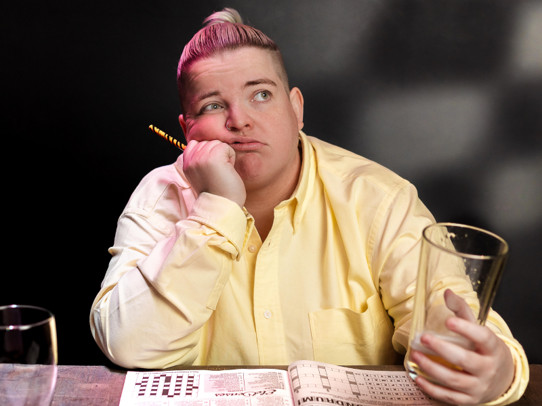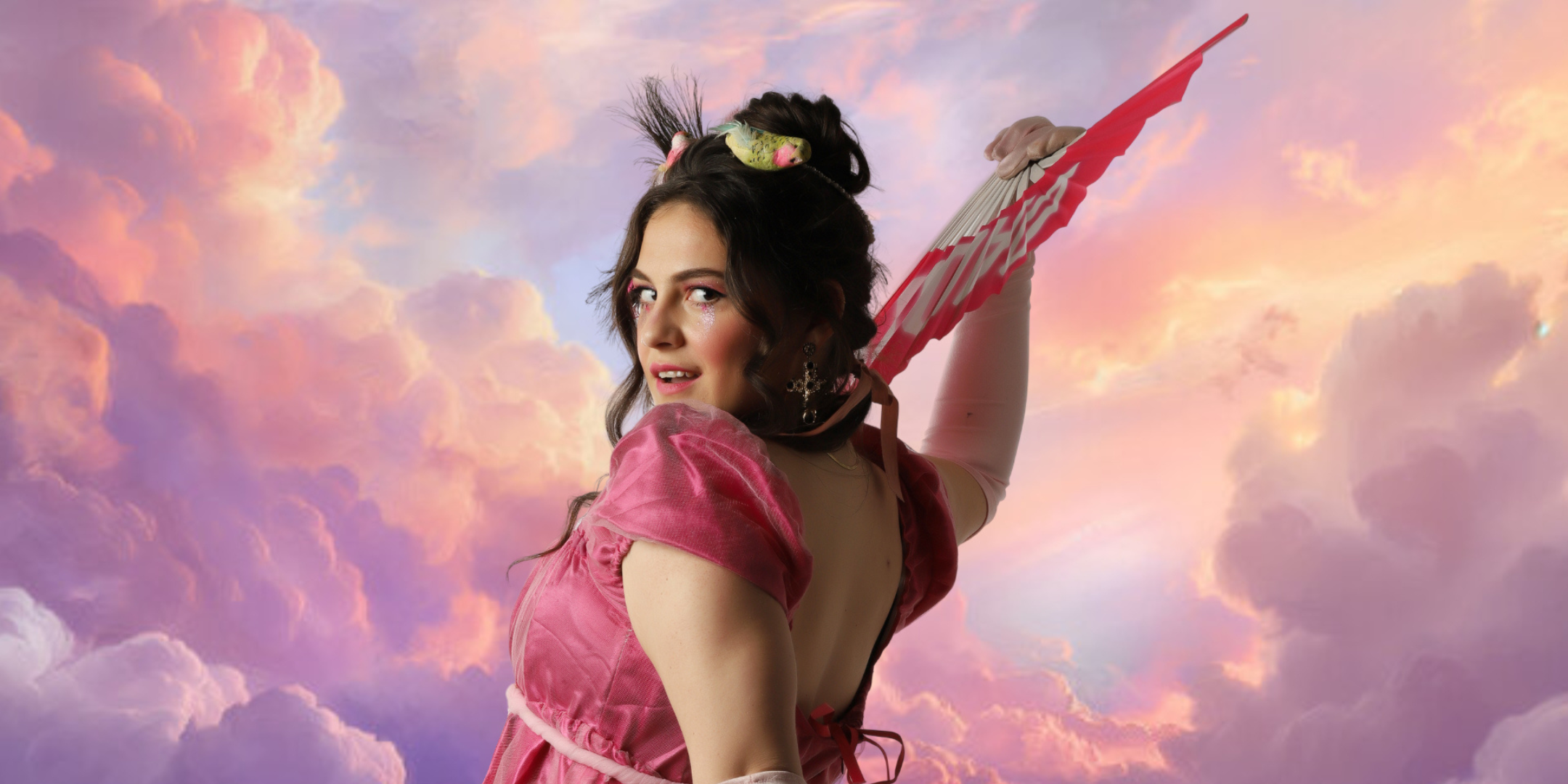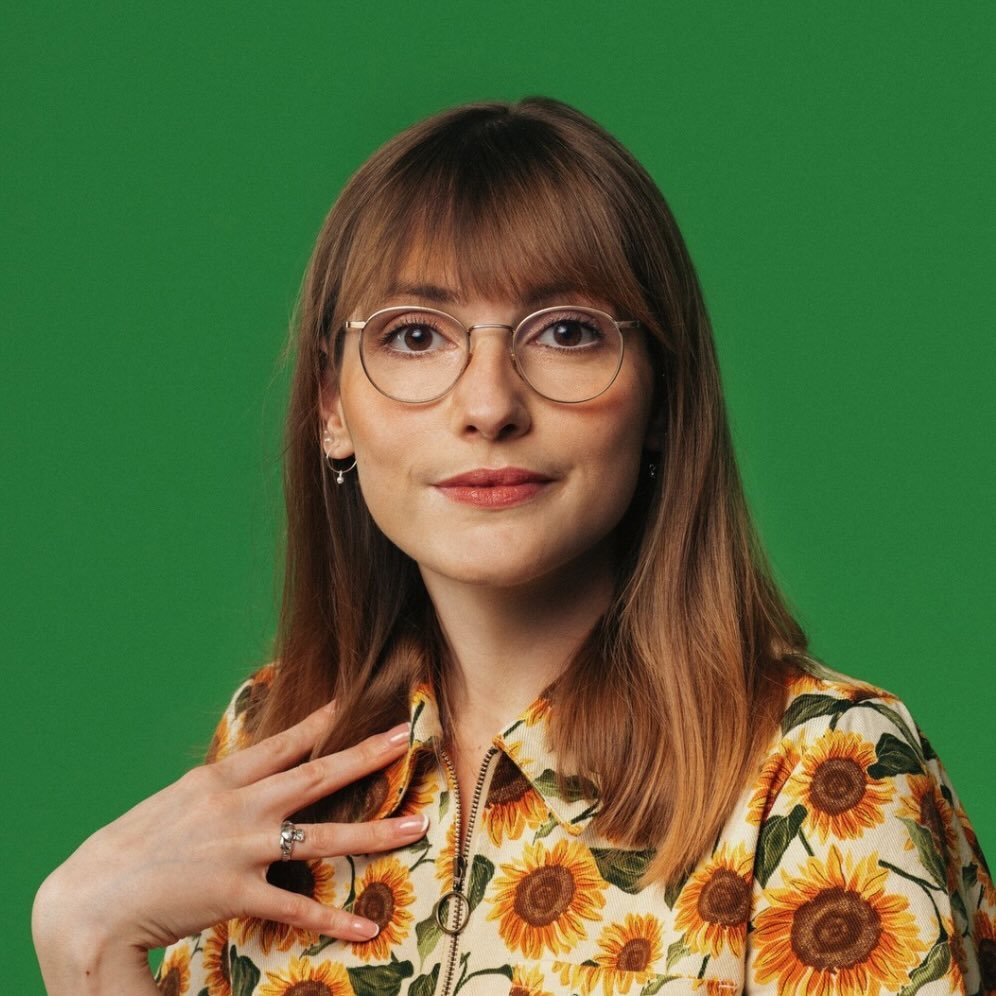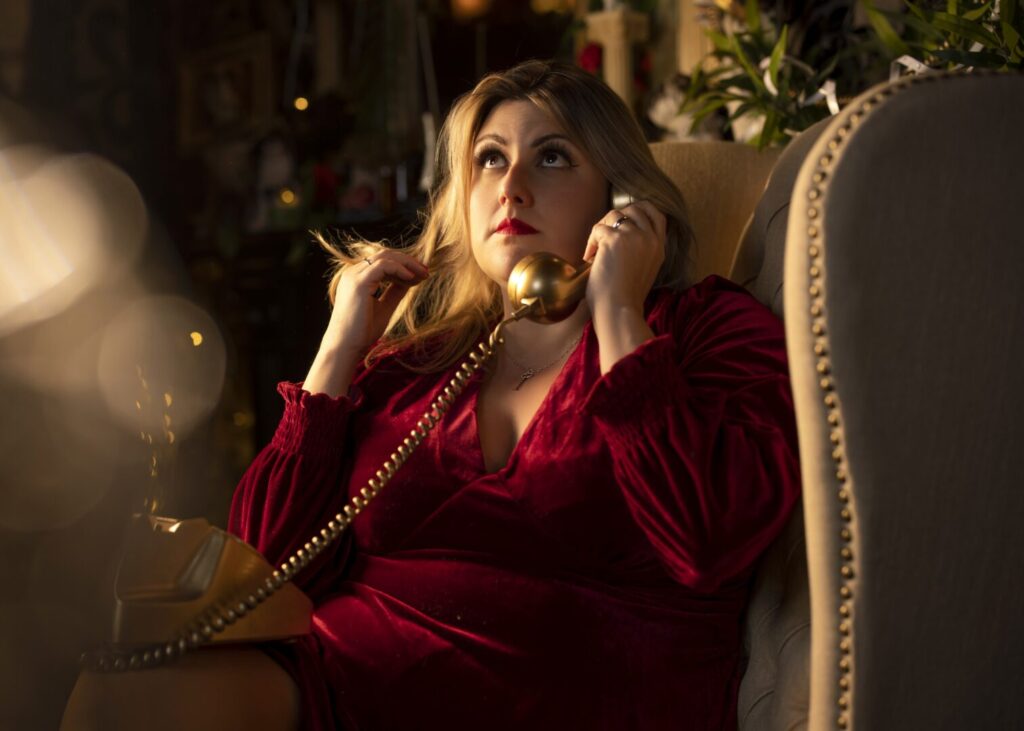
Vix Leyton is a stand-up comedian, writer and consumer finance expert with a love of history, storytelling and finding comedy in unexpected places. A Funny Women Stage Award semi-finalist, Industry Award finalist and One to Watch, she is a regular contributor across BBC radio, television and the national press, bringing the same curiosity to comedy as she does to her journalism.
How did you get into comedy?
I actually got into comedy because I was terrified of public speaking, which feels counterintuitive.
At the time I was working in PR, where standing up in front of clients and journalists was becoming an increasingly unavoidable part of the job, and I was sick of going to conferences where only men were talking, complaining about it afterwards and contributing absolutely nothing to solving the problem. So I signed up for Funny Women’s Stand Up to Stand Out course as a way of tackling the fear.
I was drunk at the time, and this is probably one of a handful of drunk decisions I can actually stand behind as a good one. The idea wasn’t to become a comedian: it was to become somebody who could get through a presentation without my brain checking out, and filling up with white noise.
The course was run by the powerhouse that is Lynne Parker, the founder of Funny Women, and at the end she asked me what I was going to do with my comedy next. It hadn’t really occurred to me that there was a next. I’d signed up to solve a problem, not accidentally find a new career.
I tweeted about the course afterwards, and in an entirely serendipitous series of events, Mark Watson saw it and got in touch to take part in his marathon show with the challenge to get over it once and for all, and everything that followed can be traced back to that one decision to do something that frightened me. Looking back, it’s remarkable how much of my life now exists because I was trying to stop being scared of speaking in public; it unlocked everything, from presentation skills to working out who I was. I can’t give credit to Funny Women for helping me eventually come out, but it probably got an assist.
Tell us about your comedy style.
For a long time, I was wedded to a fairly traditional idea of what stand-up should look like: personal, self-deprecating and built around mining your own life for material. On paper, my debut hour went brilliantly. It had solid reviews, busy rooms and all the external signs that it had worked, but I was delving into subject matter because I knew it would get a reaction before I had properly processed my own.
At the time, I was going through a divorce, had just moved to a different city and was trying to work out who I was as a queer woman. With hindsight, I tackled themes I was not ready for, and I was not prepared for the different ways audiences and reviewers would receive them. There is always a certain amount of personal experience and projection in how a show is read, and having reviews range from two stars to four really hammered home that once you put your stories on stage, you lose control of what other people make of them.
It spooked me, and for a while it scared me away from stand-up altogether. In all honesty, I thought I was done with solo hours.
Then I accidentally started writing the first show I had ever truly wanted to make. It started with an option for a Work in Progress with Square Hole, an iconic Sheffield alternative night. I took it as an opportunity to run out some of the thoughts I had on the subject that I had a rough idea to make a podcast about, and it went so well I couldn’t quite let it go.
There is also a bit of a twist in how this show came to be that will be at the end of the hour, and I’m not going to spoiler it just yet. Chief Petty Officer looks at the impact of pettiness on society through historical examples, from ancient complaints to celebrity grudges, using an increasingly elaborate framework to work out who achieved something glorious and who simply made everybody’s life worse.
It is unlike anything I have done before. It feels less like traditional stand-up and more like a curation exercise in which history is the star, yet somehow it is also the most personal thing I have ever made, because it is the first time I have stopped trying to fit myself into a template and trusted the things I am genuinely interested in.
I have gradually realised I do not have to write traditional stand-up. I write comedy for people who enjoy falling down Wikipedia rabbit holes, and it has been an absolute joy to discover that those are my people.
What have you been working on and what’s next?
Stepping back from doing stand-up on the circuit for a while didn’t mean stepping back from comedy. If anything, it gave me permission to try things I probably wouldn’t have found otherwise, and I’ve had a brilliant year so far working on projects that all scratch slightly different creative itches whilst obsessively writing and rewriting the petty hour.
One of the highlights was joining the live finale of Nicky Campbell’s Don’t Say A Word at Crossed Wires in Sheffield. As someone who now calls Sheffield home, it was a real joy to be part of the festival, a truly global event outside the capital, and I loved the chance to swap the rhythm of stand-up for a live conversation with a room full of people, talking about what goes on behind the scenes of stand-up and how you make the decisions you make with material. It’s a great podcast in general, for any writers wondering where the lines are being drawn in what you can and cannot say, and Nicky is such a legendary broadcaster, I hope I’ve learned some skills by osmosis.
I was also thrilled to be cast in Mark Watson’s murder mystery podcast Murder of a Famous Bastard, which has been enormous fun. It turns out I really enjoy stories that reward curiosity, whether that’s an unsolved murder, a historical grudge or a 4,000-year-old complaint letter. It was like being at the best murder mystery party in the world: there were some real comedy legends in the company (Lulu Popplewell, Eleanor Morton, Rosie Holt, Shaparak Khorsandi, Athena Kugblenu…), and you only ever got your own lines to record, so you could have been the killer the whole time and not know.
Who are the funny women you would recommend seeing at the Edinburgh Fringe this year?
I both love and hate this question, as I have so many women I want to remember and I will inevitably miss out.
Hannah Platt is right at the top of my list. We’ve done several work-in-progress shows together this year and every single time I’ve watched her I’ve noticed some new clever layering. She takes an expertly light touch to dark material, and really draws you in. It’s a great hour, and it wasn’t even finished the last time I saw it. I actually saw a version in February that was already so well developed, I almost grumpily downed tools on my own as it felt a world away.
Kate Smurthwaite is attempting something that feels simultaneously incredibly brave and gloriously unhinged (unFringed?) writing a brand new hour of stand-up every single day of the Fringe, using crowdsourced suggestions. As someone who’s just spent months obsessing over getting one hour right and endlessly rewriting it based on suggestions of even better stories at the end, I can’t quite get my head around it, but I also love the idea of the space and latitude it is going to give her. Whether you’re interested in comedy, creativity or simply watching somebody attempt an outrageous artistic challenge, I think that’s one of the most exciting ideas at the festival this year.
Adele Cliff’s topical show appeals to me in the same vein. One of the things I love about Edinburgh is that there are still comedians prepared to build work around what’s happening right now, knowing it’ll all have changed by the time they pack up at the end of the month. It makes every performance feel genuinely of that moment, and Adele has exactly the sort of quick brain that thrives in that environment.
I’m really excited to see what Leslie Gold does with 101 Rules for a Better World (by Comedians) this year. It’s such a genius premise, and I have a real weakness for comedy formats that inspire you to continue the argument in the pub afterwards. There’s something very joyful about getting funny people to solve the world’s problems, even if the solutions end up making things objectively worse.
Louise Leigh and Pauline Eyre’s Aaagony Aunts is another one I’m looking forward to, to watch and to be part of. It’s ambitious to try to solve anyone’s problems live on stage, let alone those of comedians. But if anyone can do it, it’ll be them.
I’d also keep an eye on Funny Women’s events at the festival. Long before I ever stepped on a Fringe stage they gave me the confidence to believe comedy might be something I could actually do, and they have an annoyingly good track record of spotting brilliant people before the rest of us catch up. If you’re looking for your next favourite comedian rather than simply the biggest name on the poster, they’re a very good place to start.
The only advice I’d give anyone coming to Edinburgh is to leave room for a recommendation. The best show I see every Fringe is almost never the one I planned months in advance; it’s the one another comedian gets excited about halfway through the festival, and tells you giddily in the street, still shouting about it as they walk away.
What is your show about?
On the surface, it’s a comedy lecture about history’s greatest petty acts, from ancient Mesopotamian customer complaints to celebrity feuds, political campaigns and pop culture grudges. Underneath that, it’s really a show about why otherwise sensible people sometimes dedicate astonishing amounts of time and energy to proving a point, and if that’s not a metaphor for the Edinburgh Fringe experience, I don’t know what is.
Like any ‘academic’, I’ve developed a framework to score each act of pettiness based on three questions: how much satisfaction did it bring the person doing it, how much inconvenience did it cause the target, and how many other people got to enjoy watching it unfold? I call it the Hill To Die On Index, because if you’re going to commit to a grudge, you may as well do it properly.
One of the biggest surprises has been how collaborative the research has become. I thought I was curating history’s greatest stories, but audiences have become this wonderful hive mind of obscure knowledge. After almost every work-in-progress somebody has come up to tell me about another extraordinary petty act I’d never heard of, or add the missing colour to a story already in the show.
I’ve had people whose families lived through historical events, people who’ve worked with the people I’m talking about, someone who literally coded 50 Cent’s video game, and people who simply know an astonishing amount about one very niche corner of history. Those conversations have made the show richer, funnier and, I hope, more human than anything I could have researched on my own.
For a long time I thought comedy had to come from looking inwards, mining my own life for stories and hoping people saw something of themselves in them. Chief Petty Officer has taught me that curating can be just as creative as creating. Choosing which stories to tell, how to connect them and where to find the humanity inside them has ended up feeling far more personal than I ever expected.
I’m a lifelong devotee of BBC Radio 4 comedy, and I think that’s probably the audience I’ve been writing for, and it’s definitely a tribute to people I love who have gone before: Sandi Toksvig’s joy in discovery, Izzard’s incredibly surrealist take on history, Dave Gorman’s love of slides, Dr Hannah Fry’s curiosity, David Mitchell’s… well, pretty much everything David Mitchell stands for.
It’s bold to try to match them, but I hope they’d be happy to have influenced it if they did ever see it. If you love the feeling of disappearing down a historical rabbit hole, coming away with half a dozen facts you’ll immediately bore your friends with and laughing far more than you expected in the process, then I hope you’ll feel right at home.
Keep up to date with Vix Leyton by following her on Instagram and Blue Sky.
Tickets and information for Chief Petty Officer can be found here!