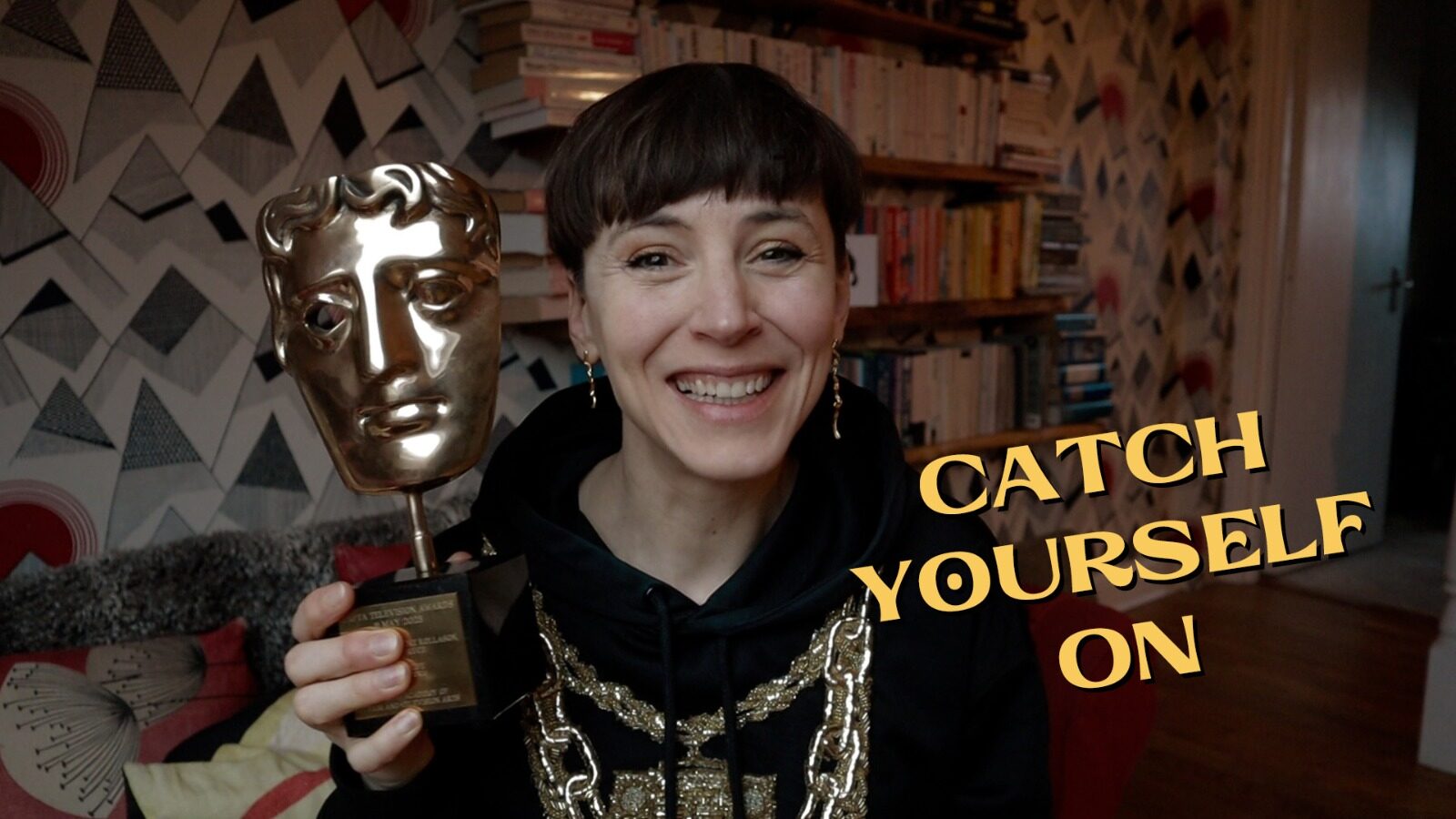
Catherine Abbott grew up in the Midlands and is now based in Glasgow. She has been directing for 15 years. Her recent film Becoming Victoria Wood has just completed a cinema run and will be on U&Gold on 12th February. Her other credits include Disco: Soundtrack of a Revolution and Travels with Agatha Christie & Sir David Suchet. Her documentary profiling the satirist, writer and director Armando Iannucci (imagine…The Academy of Armando) was recognised by BAFTA Scotland in 2025.

Image – UKTV / Rogan Productions / Phil McIntyre / Victoria Wood Personal Archive
How did you end up directing Becoming Victoria Wood?
Rogan Productions in Scotland told me that they were looking for a director for a film about Victoria Wood. For me it was a dream job – so I was determined to be the person to do it!
How did you first come across Victoria Wood, did she have an impact on your life?
I feel like I grew up with Victoria Wood. I remember watching the stand up shows, the TV specials and dinnerladies with family, and then discovering the genius of As Seen on TV which I was too young to watch when it first aired. As well the comedy, I loved her dramatic and musical work – Housewife 49, That Day We Sang. Her range was incredible, and to see a northern woman knocking it out of the park in every genre she set her mind to was incredibly inspiring.
Tell us more about what the documentary is about, and how readers can watch it!
Becoming Victoria Wood focuses on Victoria’s early life and career – including her childhood in Bury, her time at Birmingham University and her first years in the TV industry. It shows how she went from being a shy schoolgirl who played the piano in private, to the confident performer commanding huge audiences that her fans know and love. As a young woman in a male dominated industry, Victoria had to contend with misogyny and a constant obsession with her looks, as well as her own shyness, insecurity, anger and self-doubt. But the film also shows how, through persistence, hard work and an inner belief in herself, Victoria funnelled these experiences into captivating comedy that cut to heart of our flawed fixations with sex, appearance, geography and class.
Why do you think Victoria Wood resonates so strongly with audiences, even now?
I think that relatability is key, and it’s at the heart of Victoria’s work. She was also an incredible observer of people and of language. As well as being consistently hilarious, her writing was grounded and real, and we could all recognise people we had met or people we knew in the characters she created. I think another reason she resonates so strongly is that even when she became famous and successful, Victoria never forgot what it was like to feel misunderstood and overlooked. The gift that she gave her audience was to make us feel seen and heard. Maxine Peake sums is up brilliantly in the film when she says it was “therapy wrapped up in laughter”, and we’ll always need that in our lives.
What is something you discovered during the making of the documentary about Victoria that you weren’t aware of previously?
Until I read Jasper Rees’ brilliant biography I hadn’t realised how autobiographical a lot of Victoria’s work was. The more I learned about Victoria’s early life, the more I saw the comedy in a new light, and sketches I’ve always loved (like Swim the Channel or On Campus in As Seen on TV) took on a whole new meaning for me. I was also blown away by some of the early songs. We were lucky enough to be able to include a recording of Victoria singing at University in the film and Alison’s Song, written for a friend, is a brilliant piece of observation. A lot of her early songs are sad or bittersweet. Love Song, about a man who has lost his wife, is one that we feature in the documentary and it never fails to move me.
How did it feel, to sit across from so many other female comedy treasures, and hear them talk about Victoria and how she impacted their career?
I was lucky enough to meet some amazing women whom I’ve admired for years – Maxine Peake, Joan Armatrading, Dawn French and Jennifer Saunders. Dawn described Victoria as the trailblazer – she was slightly ahead of the other female comedians who were breaking through in the 80s, and she was the one who forged a path for others to follow. Maxine told us that she initially wanted to be a stand-up comedian because of Victoria and that seeing a northern woman standing on stage in As Seen on TV allowed her to believe that she could do something similar. I think there’s a whole generation of female comedians and actors out there who wouldn’t be doing what they do without Victoria. Even though she’s no longer with us, we still have so much to thank her for.
Becoming Victoria Wood premieres on U&Gold at 9pm on Thursday 12 February.